
33.4 mi / 6.0 mph / 1794 ft. climbing
Home: Abandoned House Wild Camp
With no chance of rain in the forecast, I was annoyed when sprinkles on my face at midnight forced me to get out and put the rainfly on our tent. Of course that meant the sprinkles immediately stopped and did not return for the rest of the night.
“The rest of the night” was only four-and-a-half more hours, and when we woke for real in the darkness, it was even more freakishly warm than yesterday morning. The thermometer on Rett’s bike sitting in the 3-walled shelter read 62°F, and I would have thought that it was broken if I hadn’t been able to comfortably do our entire morning routine in shorts and without a jacket, even though it was still windy. I can barely remember doing any camp mornings in such minimal clothing, and certainly not anywhere with a reputation for cold like Patagonia.
We were on the road by 6:40am, because we knew we would be fighting headwinds and gravel for much of the day. The first half of the Carretera Austral (in 2026) still has some gravel sections, and the second half now has some paved sections, but 1.5 miles into today’s ride is the point where we cross over from the “paved half” of the route to the “gravel half”, with some 280 miles remaining. At least we were granted one last stretch of concrete for a steep initial climb!


I immediately lowered our tire pressure when we hit the gravel (to something like 25-27psi on our 55mm tires), which made it seem not-terrible for the first couple miles. But when we crossed the outlet of Laguna Verde, which included a sign that said “Construction for the next 17km”, it turned into something much worse. Loose and deep stones were spread across the surface, forcing us to find rare vehicle-compressed sections to ride in. Luckily the road was quite wide (I’m guessing the “construction”, which we saw none of, is a prelude to paving), so we soon began just riding in the middle (furthest from the deep piles lining the edges), and vehicles coming from behind generally had no problem figuring out that they should pass us on the right.

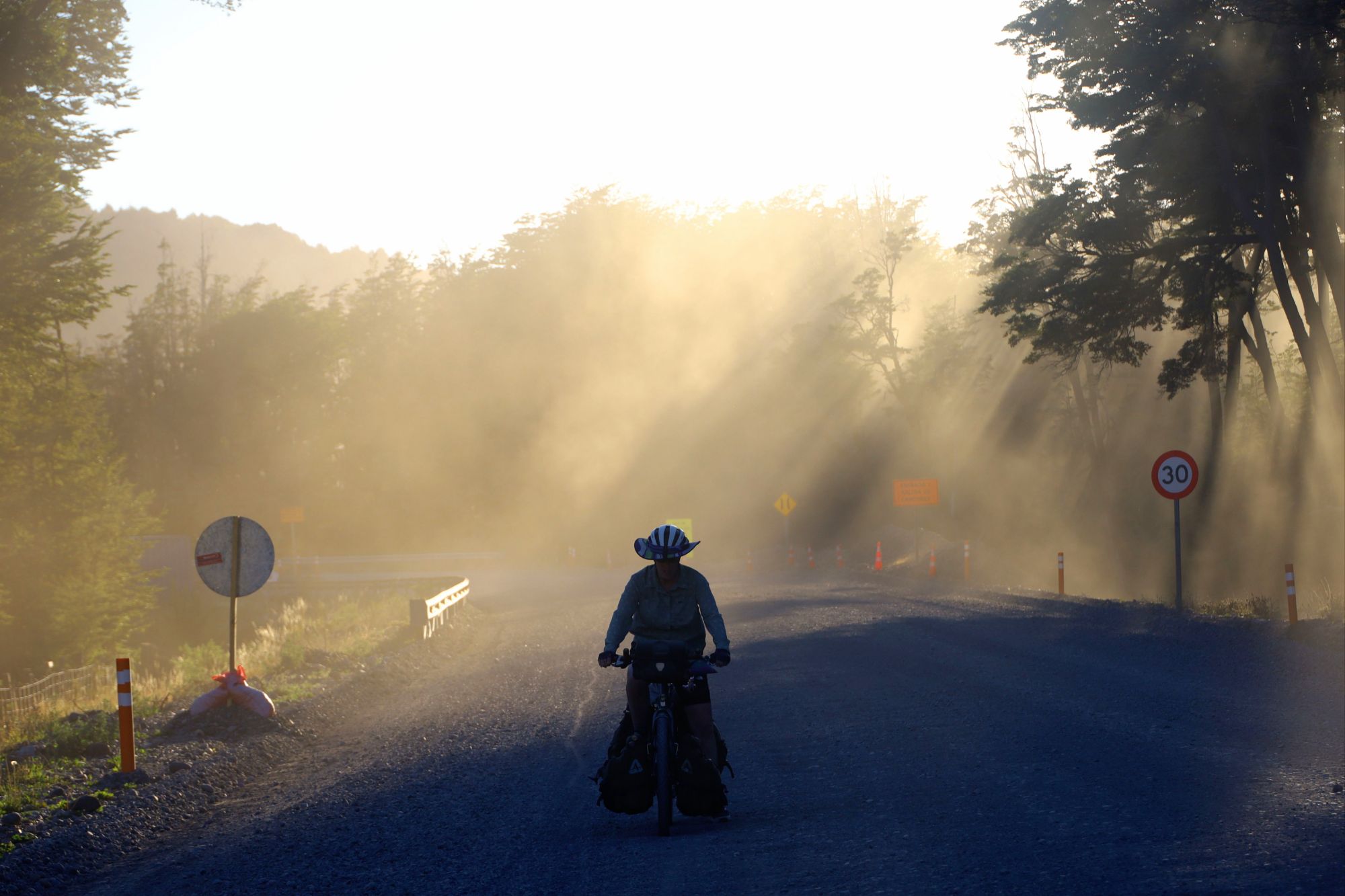


The challenges of the surface were compounded by Rett’s still-low confidence after her crash on washboarded gravel on our crossing from Argentina before Christmas. So a loose line that she might have plowed through without concern two months ago, now made her jerk to a halt, dismount, and worst, berate herself for her entirely-reasonable apprehension. From my experience of admiring her ever-improving skills since she first learned to ride a bike 13 years ago, I knew that time and testing by the road would gradually rebuild that confidence within her, but even more amazing, she knows it too on an intellectual level, even while her emotions are screaming at her to stop and curl up into a ball. So I love how she kept pressing on, despite having to fight both the gravel and those emotions. And even if she failed 5 out of 100 micro-tests in a mile, she passed 95, and that meant in the next mile she passed 97, and after a few more miles was passing 99.


Despite her improvement, it was still slow-going and fairly exhausting (especially with the headwind), so Rett was still despairing that we would never be able to ride the 40 more miles to our destination in this stuff. But my hope was that the surface might improve once we reached the end of the 17km “construction” zone. And it did, though not without tradeoffs. The deep and loose tire-swamping pools disappeared, but were replaced by a rocky and washboarded surface, and a significant narrowing meant that we had fewer lines to choose from.
The road here heads straight west along the broad Ibañez River valley for some 30 miles, making it a notoriously windy section. We were riding it on a relatively non-windy day (as planned after watching the forecast), but even if the broader forecast shows west winds at a mere 6mph, that’s only because it is generally frustrated by all the steep and convoluted mountains blocking its preferred path. So when a bit of it discovers this valley that it can flow freely down, it excitedly calls over every single one of its friends in a 10-mile range, and they all gleefully come blasting at us with a gathered momentum far higher than that background level of 6mph. Especially when the road would curve out from behind a cliff and fully expose us. But everything there followed the plan, so even though the wind in this localized valley was already going from the first moments of morning (in contrast to most mornings where it has been completely calm), it didn’t really increase in speed as the day went on. It surely made the day more difficult, but the gravel and the hills remained the dominant challengers. When you’re going really slow already, the wind can’t do much more to slow you down further! And since it never gusted at us from the side, it was never the element that forced a walk.
A steep 400 foot climb out of the valley was blessedly graded into a super-smooth surface, so even though it returned to rocky washboards for the low-slope climb after that, we at least got a good break when we needed it. We found an open gate in the endless fencing and were able to set our chairs up on the other side in a nice wooded area to eat lunch, one of the few places where we could get far enough off the road to prevent the dust clouds flung up by speeding cars from becoming part of our meal.


As well as she had done, Rett was tiring out, with her exhaustion perhaps aided by whatever was upsetting her stomach. It was clear that this would be a rare day where it wouldn’t make any sense to try reach our planned target, especially when there were multiple options to allow us to stop sooner. The fact that Rett walked for most of the last mile up the mild hill before reaching our first bailout option told me it was best to stop there. But the riverside wild camp, while generally quite good, would have been in the hot sun all afternoon, and after washing up in the stream, and taking a break while I scouted the site and then went looking for water, she felt good enough to risk five miles down the big hill to the next option.


Our second target was the winner, an abandoned house that has been a popular cyclist haven for years. We didn’t actually need refuge from weather like many past travelers have, and there was plenty of space around it to pitch our tent, but none of it was hidden from the road. So after naked river baths in the broad Murta that flows right behind the house, we brought our bikes inside just to sort of claim a space. Because the one downside of this “camp” was that its popularity could likely mean that we would be joined by others at some point.
Rett’s late rally soon faded though, and I quickly inflated our mattress and put it down on the floor so she could lie down and try fight off her wooziness and nausea, while I took care of chores and got dinner started.
I went out and talked with a young cycling couple who had stopped, learning they were from Seattle, and even Redmond specifically, our one-time home. But they had more riding to, as did a couple others we saw go by outside our “window”, as usual far later than we would ever choose to still be riding. So with no one else stopped as the sun went behind the mountain, I decided it was easiest to just keep everything inside and I set up the tent inside the house. Tomorrow now had to be longer-than-planned to make up for today’s shorter-than-planned ride, but now the days would be more equal, which is probably how I should have designed it to begin with.


Leave a Reply